
- Home /
- Blog
The Hidden Cost of Missed Medical Appointments for Seniors
A cancelled appointment registers as a small administrative event. A phone call, a note in a system, a new slot three weeks out. For an otherwise healthy adult that is usually the whole story.
For an older adult managing a chronic condition, the cost is real but delayed, which is why it is so consistently underestimated. The appointment that did not happen in March is rarely connected to the hospital admission in May, even when the line between them is direct. This article is about what actually happens in that gap.
Key Takeaways
- The cost of a missed appointment is a period without monitoring, not the appointment itself.
- Rescheduling typically adds weeks, not days, which is long enough for a chronic condition to change direction.
- Transportation and mobility, rather than reluctance, are the most common causes.
- Once one appointment is missed, the probability of missing the next one rises.
- Removing the travel requirement removes most of the causes at once.
Why appointments get missed
It is worth being precise about the reasons, because the assumption that patients are being careless leads to the wrong solutions.
Transportation is the largest single factor. An older adult who no longer drives depends on a family member taking time off work, a paid ride, or a scheduled medical transport service that may require booking days in advance and may arrive late. Any one of those failing cancels the appointment.
Mobility and stamina come next. For someone using a walker or recovering from surgery, an appointment is not a thirty minute event. It is a whole day: getting dressed, getting into a vehicle, traveling, waiting in a waiting room, being seen, and traveling home, followed by a day of recovery. Weather turns that from difficult into impossible for several months of an Ohio year.
Then there are the ordinary complications. Multiple specialists with uncoordinated calendars. Caregiver illness. Cognitive difficulty tracking dates. Cost concerns. Anxiety about what might be found. None of these are unusual and none of them reflect indifference.
What the gap costs clinically
The appointment is not the point. Continuous monitoring is the point, and a missed appointment is a hole in it.
Chronic conditions are managed by observing trends and adjusting. Blood pressure drifting up, weight climbing in heart failure, kidney function declining, a wound that has stopped shrinking. Each of those is manageable when caught at the point it starts and considerably harder once six or eight weeks have passed. The consequence is not that treatment becomes impossible. It is that the response shifts from a small adjustment to a larger intervention.
Medication review is affected in the same way. Older adults frequently take multiple prescriptions from multiple prescribers, and reviewing that list is one of the highest value activities in geriatric care. It does not happen at appointments that do not occur.
Wounds show the effect faster than most conditions
Wound care is a useful illustration because the timescale is compressed. A wound can change direction in days.
A dressing left in place too long can macerate the surrounding skin. An early infection that would have been caught at a scheduled check has two more weeks to establish itself. A wound that has stalled continues to receive treatment that has already been shown not to work, because nobody has measured it.
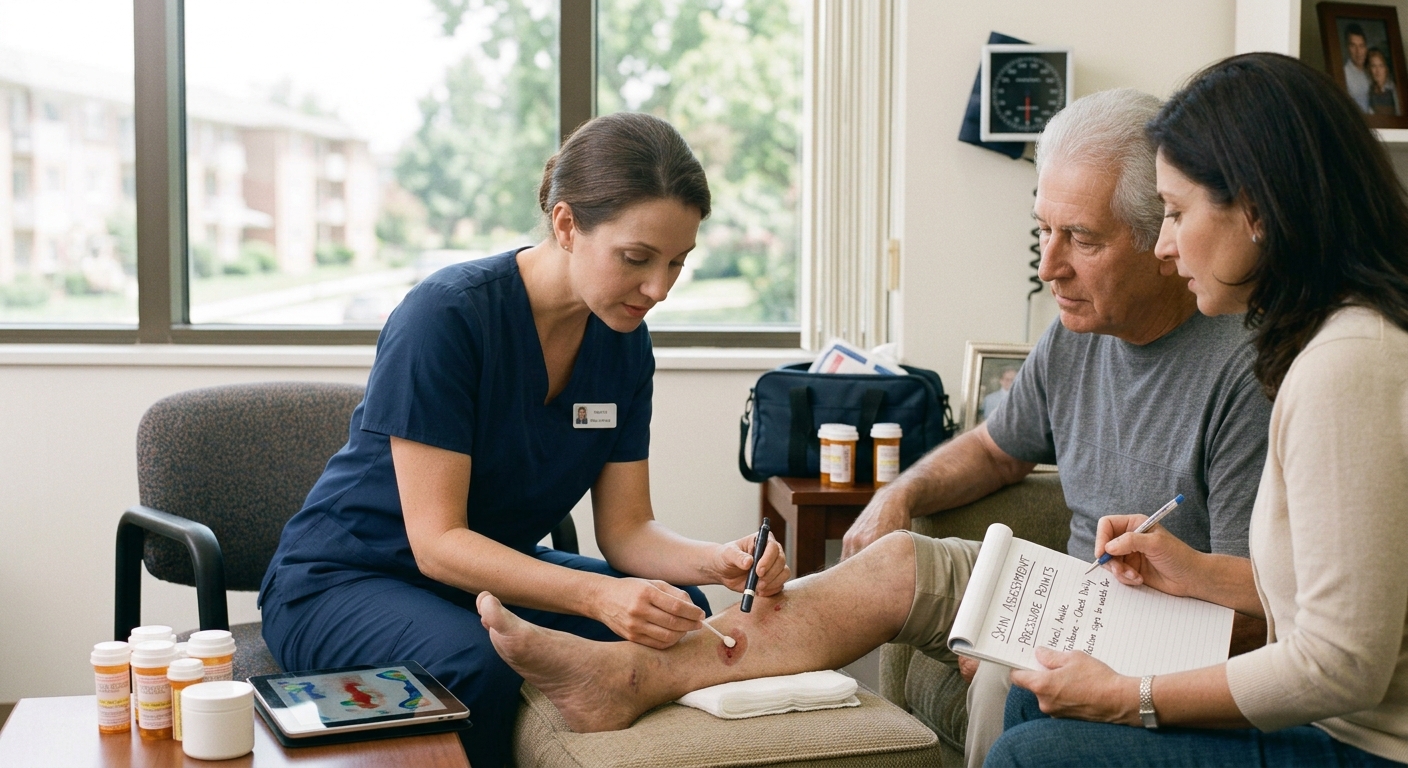
This is one of the clearer benefits of professional wound care delivered in the home. The visit that would have been cancelled goes ahead, the measurement series stays unbroken, and a wound moving in the wrong direction is identified in week one rather than week four.
The point is sharper still in diabetes, where reduced sensation means a deteriorating foot ulcer may cause no pain whatsoever. The diabetic foot guidance from MedlinePlus is unambiguous about the value of regular inspection for exactly that reason: the patient cannot rely on symptoms to tell them something has changed, so somebody has to look.
The costs that do not appear in medical records
Several of the real costs land outside the healthcare system entirely.
Caregiver time. A single appointment often costs a working family member a full day of leave. Across several specialists and several months, that becomes a significant amount of income and a significant amount of goodwill at work.
Transportation expense. Paid rides and medical transport add up quickly for patients on fixed incomes.
Physical decline. A demanding trip can leave a frail patient depleted for days, reducing activity and appetite in a population where both matter.
Emergency use. When routine monitoring lapses, problems tend to be discovered at their acute stage, and the setting for that discovery is often an emergency department. That is the most expensive, most disruptive and least appropriate place to manage a chronic condition.
Confidence. After a missed appointment and a long wait for a new one, patients frequently disengage. The next appointment is easier to skip than the last, and families often describe the point at which an older relative stopped treating their own follow ups as important. That shift is difficult to reverse once it has happened, and it usually starts with a logistical failure rather than a decision.
Where the pattern usually starts
| Trigger | What tends to follow |
|---|---|
| One appointment cancelled for transport | Rescheduled three to six weeks out |
| Symptom changes during the gap | Not observed by anyone clinical |
| Next appointment feels harder to justify | Second cancellation becomes likelier |
| Condition deteriorates unmonitored | Presentation at urgent or emergency care |
| Recovery from the acute episode | Return to a schedule that is harder to keep than before |
The chain is not inevitable, but it is common, and it usually begins with a logistical problem rather than a medical one.
Removing the trip removes most of the causes
If transportation, mobility, stamina, weather and caregiver availability are the main reasons appointments are missed, then care delivered at home addresses nearly all of them at once. There is no journey to arrange, no waiting room, no day of recovery afterward and no leave to book.
There is a clinical benefit as well. A clinician in the home sees the environment: the chair the patient spends most of the day in, the mattress, the footwear by the door, what is actually in the kitchen, how many steps it takes to reach the bathroom. Those details explain a great deal that is invisible in a clinic room, and they frequently explain why a wound is not healing.
Conclusion
The cost of a missed appointment is not the slot. It is the weeks of unmonitored time that follow it, the larger intervention that becomes necessary as a result, and the gradual disengagement that tends to follow a difficult rescheduling experience.
For patients where getting to a clinic is the hard part, bringing the clinician to the patient is the most direct fix available.
Inspiring Minds Wound Care provides specialist wound assessment and treatment in the home across Ohio, with certified wound care specialists, coordination with your existing physicians, and coverage verified before the first visit. Call (614) 324-7500 or email [email protected]. Visits run Monday through Saturday, 8:30 am to 5:00 pm.